

Imagine that you are a millennial director given the chance to revive your favourite slasher franchise. In a movie landscape stuffed with tired remakes of existing IP (2025’s zombified Lilo & Stitch, anyone?), you decide to go back to the beginning and cast the original ‘final girl’, now in her sixties and secluded at the same camp that the original film depicted. She is waiting for you – and so is the series’ villain; Little Death is waking up.
Teenage Sex and Death at Camp Miasma is the third in director Jane Schoenbrun’s ‘Screen’ trilogy, beginning with creepypasta chiller We’re All Going to the World’s Fair, followed by I Saw the TV Glow. The latter is a masterpiece of genre cinema, where the traditional horror scares are slim, but offering such a haunting story of lost identity that it becomes uniquely horrifying.
Each film in the trilogy presents a fictional universe that contains within it the tools to become who you need to be. And so in this finale Schoenbrun’s camera is trained - (bloody) body and soul - on desire.
Aforementioned millennial director Kris (performed by Hannah Einbinder) is polyamorous and queer, trekking into the snowy climes of Camp Tivoli while on the phone to her partner back in LA, who’s simultaneously fawning over a chiselled lunk named Thor. We’ve all been th- no? Just me? Alright.
Teenage Sex and Death at Camp Miasma hit cinemas in the same week as Dolly Parton’s death, and Gillian Anderson’s Billy Presley evokes a similar kind of Southern sensuality. She has a wicked cackle, flowing blonde locks, and somehow makes trashy candy and KFC dipping sauces erotic. Through her vices and her allure, she represents a lack of inhibition that Kris is desperate to attain for herself. Kris is from a generation of disconnection, where you can date multiple people at once but find yourself lacking any meaningful intimacy without taking yourself ‘far away’ – and Billy knows how to get her there, with spectacularly gory results.
The slasher is a subgenre of horror perhaps more preoccupied with gender and sexuality than any other. Emerging in the years after the 1967 ‘Summer of Love’, critics and academics have argued that the women who fall victim to masked killers, like Jason Voorhees and Leatherface, are chosen because of their promiscuity and dangerous lifestyles. A violent response to the perceived excess of the ‘60s. The ‘final girl’ escapes because she is virginal, pure – and to act as a warning to other amorous teens: Keep your hands to yourselves, or this might happen to you.
Running counter to the trope, Billy has found a certain kind of sexual liberation through her experiences. Schoenburn offers the idea that fear and desire are often two sides of the same coin in her. This Billy shares with Kris, and as the two become closer, the veil between her real life and the one on her gas-station DVDs begins to fall away.
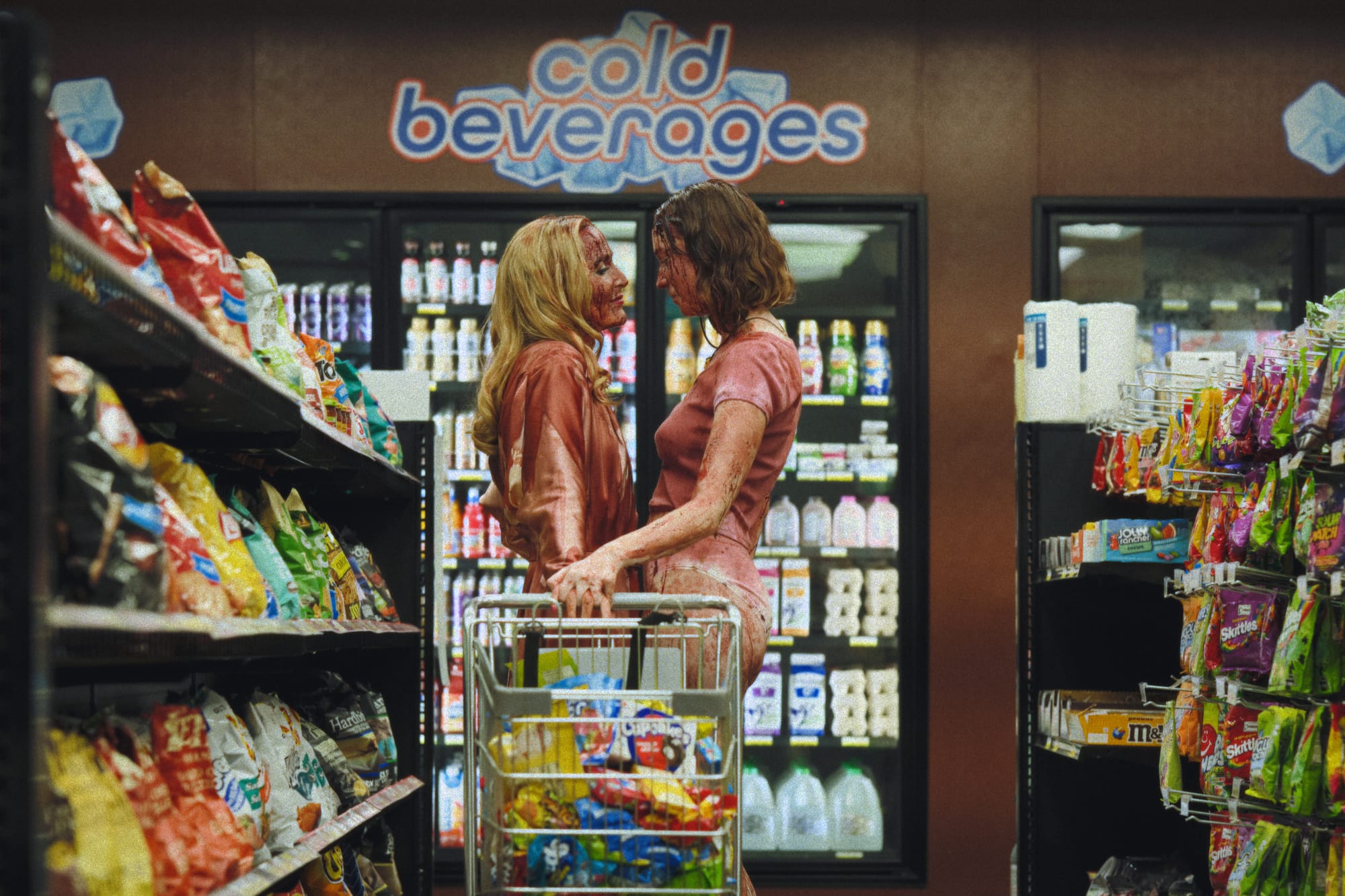
Throughout this film, the physical body acts as the site of release but also of repression, needing to be destroyed before it can be remade. And boy is it destroyed, as geysers of fake blood erupt around Little Death. The costumed villain, played with enigmatic glee by TV Glow’s Jack Haven, emerges from the subterranean video store at the end of the world, having been placed there in an act of suppressive bigotry. They mow down those responsible until they reach a sanguineous climax that - well, if the double-entendre behind the villain’s name wasn’t obvious before, Kris leaves it in no doubt.
I’m prepared to admit that this film will likely be too metatextual for many, and will pose more questions than answers. Is the cinematic experience itself being presented as voyeuristic? Are both the canon original Camp Miasma and the one we’re watching films-within-films? In a sequence near the end where the membrane between reality and the world of the sleepaway camp is especially porous, there’s a look over the shoulder at Schoenbrun themselves, setting up a beautiful painted-glass shot we’ve seen earlier in the film. Kris points out camera techniques - notably the “split diopter!”- only for them to be replicated again in the ‘real’ world. At one point, watching a tense moment in the slasher film, only for the period-accurate projector to ominously stall, she says, “I feel like there should be a jump scare.”
Schoenbrun has been open about the parallels between their films and their own life. In this case, it serves partly as an allegory for the way they approached sex after coming out as non-binary. But just as in World’s Fair and TV Glow before, they take us into their world and present it in the fuzzy trappings of the CRT era for everyone to find something in. If you can’t make out the signal, there’s no shame in it; in the universe of Teenage Sex and Death at Camp Miasma, there’s no need for that emotion.
Teenage Sex and Death at Camp Miasma (15)
★★★★☆
112 minutes. In cinemas.


